
 5 min read
I tools have become a game-changer in boosting productivity, but how exactly does The Evenstar team use them?
A quick overview of what AI our team uses:
The Evenstar team is proficient in technologies like JavaScript, PHP, HTML/CSS, Angular, React, TypeScript and etc. Copilot supports all these. Developers using Copilot as an IDE extension can input natural language, and Copilot offers code suggestions in the selected languages. However, checking the AI-generated content is essential to ensure the AI produces precisely what you want. You can’t expect good suggestions from Copilot if the code is unclear, confusing, or unorganized with comments and standard variables (in programmer jargon, we call it 'spaghetti') First, a good AI assistant must follow a proper task by the programmer. Clients can be sure that the code generated with AI copilots, like Copilot, can be as reliable and maintainable as human-written code. While Copilot excels at simple routine tasks, it might not be the best for solutions demanding originality and creativity. However, Copilot excels in conducting code reviews, refactoring, and autotests. All in all, this tool helps with the process of making more reliable and quality code.
It makes sense to use GitHub Copilot in the following cases:
So, should the agency’s work be more cost-efficient if AI assistance helps to boost productivity? Eventually, only programmers are actively involved in decision-making and problem-solving. Workflow is optimized with Copilot hint, which creates more space to bring efficient and unique ideas to the table. You are paying for quality results. Many people fear using Copilot due to concerns about its safety and what it transmits to the server. However, you don't need to install Copilot on your device; it only accesses the file you're working on online. While this provides the AI with context, it's insufficient for the AI to replicate or appropriate your unique ideas. Moreover, GitHub has issued a statement about data collecting. Our team is always transparent, and in case we want to use AI assistance in your project, we would discuss it beforehand.
ChatGPT understands human language and produces responses that resemble human writing. It can handle follow-up questions, admit mistakes, challenge premises, and reject results. ChatGPT demonstrates its value when developers require assistance with general-purpose coding tasks, like boilerplate code generation, algorithm implementation, and data transformations. In contrast to Copilot, which offers code hints, ChatGPT can provide comprehensive answers to questions, optimizing the need for internet searches and saving time.
We use ChatGPT for:
2) Refactoring existing code to make it more readable, maintainable, and performant.
5) Building functional prototypes of applications that save time and effort in the early stages of development.
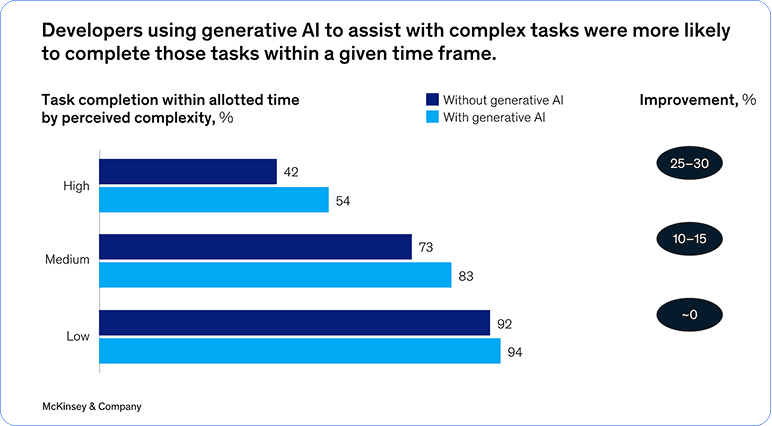
ChatGPT's limitations, rooted in its training data, mean it might not be updated with the newest language features, libraries, or frameworks. Additionally, it could occasionally suggest incorrect or inconsistent code due to the constraints of its training or a lack of industry-specific insights. While OpenAI is actively addressing these concerns, they persist. GitHub CEO Thomas Dohmke noted that Copilot AI can currently draft up to 40% of a programmer's code, with aims to reach 80% in the next five years. While AI tools in 2023 present impressive potential, they aren't without flaws. Here's how we can leverage them today:
Recent Posts